
Your sales team responded to a hot inbound lead. They had budget. They had authority. They were ready to buy. And you lost them anyway.
Not because your product was wrong. Not because your pricing was off. You lost them because you took 47 minutes to respond instead of 5.
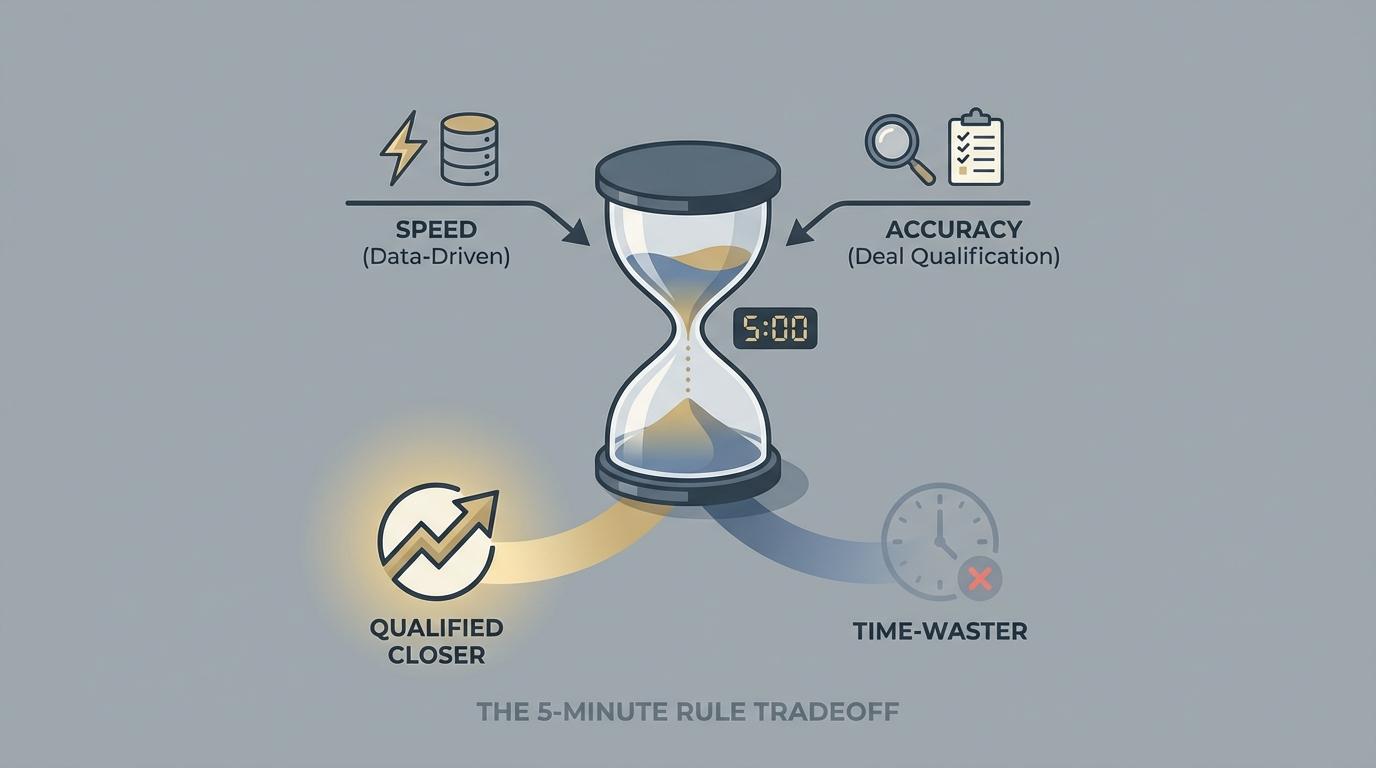
Here is what is crazy: A Harvard study confirmed that responding within 5 minutes makes you 21 times more likely to qualify that lead compared to waiting just 30 minutes. Twenty-one times. That is not a marginal improvement. That is the difference between a thriving pipeline and an empty one.
But speed alone is not the answer. Responding fast to garbage leads just means you are wasting time faster. The real skill is knowing which leads deserve those precious first five minutes.
The Uncomfortable Truth About Your Lead Quality
Let me share some numbers that should make you uncomfortable. According to recent sales research, 67% of lost sales result from improper lead qualification. Not bad products. Not weak closing skills. Just talking to the wrong people for too long.
It gets worse. Only 25% of marketing-generated leads are actually high enough quality to advance directly to sales. That means three out of every four leads your team is chasing probably should not be in active pursuit right now.
Sales reps spend only 28% of their time actually selling. The rest disappears into manual follow-ups, data entry, and chasing leads that were never going to close. Up to 40% of their time goes to just searching for someone to call.
But here is the thing: companies that prioritize lead qualification see 20% higher close rates and 30% less wasted time. The math is clear. Better qualification equals better results.
Why Most Qualification Frameworks Fail
You have probably heard of BANT. Budget, Authority, Need, Timeline. It has been the default qualification framework for decades. And for simple, transactional sales with short cycles, it still works fine.
The problem is that BANT was designed for a different era. When a prospect had limited options. When information asymmetry favored the seller. When buyers actually needed salespeople to learn about solutions.
Today, your prospect has already done their research before they ever talk to you. They have read reviews, compared features, watched demos on YouTube. By the time they raise their hand, they might be further along in their decision than your qualification framework assumes.
Top performers are 588% more likely to follow a qualification methodology. But the methodology matters less than the discipline of using one consistently. The goal is not to find the perfect framework. It is to find one that matches your sales cycle and stick with it.
Speed Versus Accuracy: The False Choice
Sales leaders often treat speed and accuracy as opposing forces. Move fast and you will waste time on bad leads. Be thorough and you will miss opportunities to competitors who responded quicker.
This is wrong. The real question is not speed versus accuracy. It is knowing when each matters most.
For transactional sales with lower deal values, speed wins. BANT works here precisely because it is simple. Can they pay? Can they decide? Do they need it? Are they ready? Four questions, quick disqualification, move on.
For complex enterprise sales with longer cycles and bigger stakes, accuracy wins. Frameworks like MEDDIC help you understand the entire purchase process, improving forecast accuracy for those high-value deals worth pursuing carefully.
The mistake is applying the wrong approach to the wrong deal type. Using MEDDIC on a small transactional sale is overkill. Using BANT on a six-figure enterprise deal is negligent.
The Real Cost of Being Too Strict
Here is something qualification frameworks rarely address: false negatives. You know about disqualifying bad leads. But what about accidentally disqualifying good ones?
Research shows that 50-80% of incoming B2B leads are unqualified, but that does not mean they are wasted. Many are simply not ready yet. They need nurturing, not rejection.
Being too strict with your qualification criteria can prevent high-value accounts from ever making their way to your sales force. A prospect who does not have budget today might have budget next quarter. A contact who lacks authority might introduce you to someone who does.
The goal with lead scoring is not to be too strict or too lenient. You want to identify which leads need immediate sales attention, which need nurturing, and which should be deprioritized. Three buckets, not two.
Using Data to Qualify Smarter
Only 44% of companies use lead scoring systems to assess lead quality. That means over half are still relying on gut feel and manual review. No wonder 69% of sales reps missed quota in 2025.
AI-based lead scoring tools integrated with CRM systems are increasingly valuable. They analyze buyer intent data, past interactions, and engagement levels to identify serious prospects before a human ever gets involved.
But the technology is only as good as the data feeding it. If your CRM is a mess of incomplete records and stale information, no algorithm will save you. Clean data comes first. Automation comes second.
The best teams combine automated scoring with human judgment. Let the system handle the initial filter. Let your experienced reps make the nuanced calls on edge cases. Neither approach works as well alone.
The 5-Minute Framework in Practice
Here is how to put this together. When a new lead comes in, you have five minutes to make a decision. Not five minutes to close the deal. Five minutes to categorize it.
First, check the basics. Does this person match your ideal customer profile? Company size, industry, role, geography. This takes 30 seconds with decent data.
Second, assess the signal. How did they find you? What content did they engage with? Are they asking about pricing or just browsing? Intent signals matter more than demographic fit.
Third, make the call. Hot leads get immediate outreach. Warm leads go into a nurture sequence. Cold leads get deprioritized but not deleted.
Fourth, execute. If it is hot, pick up the phone right now. Not in an hour. Not after lunch. Right now. Remember: 10x drop in qualification success when response time exceeds 5 minutes.
Fifth, document. Whatever you learn in that first conversation, capture it. Your future self and your colleagues will thank you.
What This Means for Your Pipeline
Average B2B win rates have declined to the 17-20% range. Most sales cycles increased by 16% in 2024. The bar is getting higher, not lower.
The teams that thrive in this environment share a few traits. They respond fast to the right leads. They disqualify quickly without burning bridges. They use data to make decisions. And they follow their qualification process consistently, not just when it is convenient.
You cannot control your prospects. You cannot control the economy. You cannot control your competitors. But you can control how fast you respond, how smart you qualify, and how disciplined you stay.
Five minutes. That is your window. Use it wisely.