
You had great calls. The prospect seemed excited. They asked all the right questions about pricing and implementation. Then… nothing. Emails go unanswered. Calls hit voicemail. Your carefully crafted deal just vanished into the void.
Sound familiar? You are not alone. Research shows that a third of businesses experience leads going silent mid-cycle, often without any explanation whatsoever. And that number is climbing as buyers face tighter budgets and longer decision-making processes.
Why Buyers Ghost (It is Probably Not About You)
Here is the thing: when a prospect goes dark, most sales reps immediately assume they did something wrong. Maybe the demo was not compelling enough. Maybe the pricing scared them off. But the reality is usually far less personal.
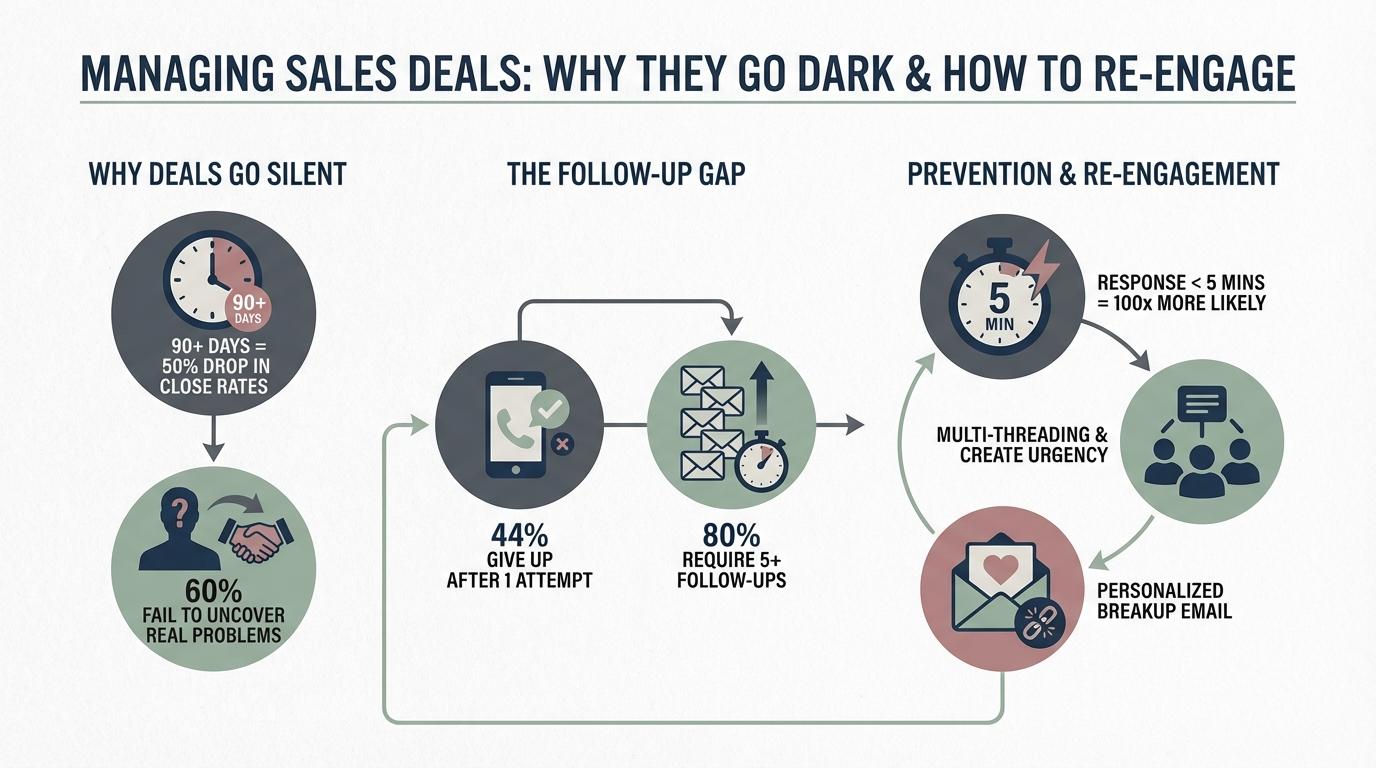
According to recent data, 60% of buyers say sellers simply do not uncover the real business problem. That disconnect creates a gap between what you are selling and what they actually need solved. When that happens, your solution just stops feeling urgent.
Timing plays a massive role too. B2B buyers spend only 17% of their time meeting with potential suppliers. The rest goes to internal meetings and independent research. Your solution might be perfect for them, just not right now.
The buying landscape has also gotten more complex. The number of firms with six or more stakeholders has nearly tripled in just two years. Some decision-making units now involve ten or more people. When that many voices need alignment, deals stall, and your contact might not even know what to tell you.
The Real Cost of Deals Going Dark
When prospects stop responding, the damage goes beyond a single lost opportunity. Research from Gong.io shows that deals extending beyond 90 days see close rates drop by nearly 50%. Every week of silence makes conversion less likely.
The frustrating part? More than 75% of sales professionals believe a deal will close when they send the contract. Yet nearly half of them report that deals go dark about 25% of the time at that exact stage. That confidence gap costs companies real revenue.
And here is what really hurts: 71% of buyers who ghost after a demo never re-engage. Once they go silent, the window to bring them back is incredibly narrow.
Re-Engagement Strategies That Actually Work
So what do you do when a deal goes quiet? The instinct is to send more emails, make more calls, push harder. But desperation kills deals. Every “one more email” can leave a worse taste in the buyer’s mouth.
The most effective approach is strategic, not persistent.
1. The Personalized Breakup Email
This sounds counterintuitive, but it works. Send a message acknowledging that you are stepping away if they are not interested, while keeping the door open for future opportunities. One practitioner sent this approach to 13 ghosted prospects. Nine took the meeting, and three became clients. That is a 23% conversion rate from dead deals.
2. Multi-Threading Your Contacts
If you only have one point of contact at a company, you are vulnerable. When that person goes dark, your entire deal goes with them. The solution is multi-threading, which means building relationships with multiple stakeholders.
Try connecting with at least five people within a target company, including two decision-makers. When one contact goes silent, others can help you re-engage or at least tell you what is happening internally.
3. Creating Genuine Urgency
Buyers only deal with their top one or two priorities at any given time. If your solution is not in that top tier, it gets pushed aside. To move back up, you need date-driven urgency that connects to their bottom line or top line.
This does not mean artificial deadlines or fake scarcity. It means understanding their business cycle and timing your outreach around events that actually matter to them: budget cycles, fiscal year ends, seasonal demands, or competitive pressures.
4. The Value-First Approach
Instead of asking for their time, give them something valuable. Share a relevant case study. Send industry data that affects their business. Offer a quick insight based on your conversation. Make every interaction add value rather than extract attention.
Prevention: Stop Deals from Going Dark in the First Place
The best re-engagement strategy is not needing one. And the data on prevention is crystal clear.
Speed Matters More Than You Think
Leads contacted within the first five minutes are 100 times more likely to convert. Wait 30 minutes, and the likelihood of qualifying that lead falls 21 times. After one hour, your chances of making contact drop by 10 times. After a full day? Your odds decrease by 400 times.
That is not a typo. Four hundred times. Speed to lead is not a nice-to-have; it is make-or-break.
Follow-Up Frequency and Timing
Here is what is crazy: 80% of sales require at least five follow-ups, yet 44% of sales reps give up after just one attempt. Only 2% of sales happen on the first contact. By the fifth through twelfth contacts, that is when 80% of sales actually close.
But timing matters. The optimal gap between follow-ups is 2 to 5 days. Waiting three days between emails results in a 31% increase in reply rates. After five days of silence, your chances of a response drop to just 24%.
The Right Time to Reach Out
For emails, aim for 10-11 AM in your prospect’s time zone, or 1 PM for highest reply rates. Avoid noon, which is the least effective time for opens.
For calls, early mornings (8-10 AM) and late afternoons (4-5 PM) tend to work best. These are windows when people are more likely to pick up and actually engage.
Ask Better Discovery Questions
Remember that 60% of buyers feel sellers do not uncover the real problem? That disconnect starts in discovery. If your demo features do not connect directly to what the buyer shared as their challenges, engagement drops immediately.
Take more time in discovery. Ask follow-up questions. Dig into the “why” behind their stated needs. When your solution feels personally relevant to their specific situation, they have far less reason to ghost.
The Follow-Up Framework
Putting this all together, here is a practical framework:
Immediate (within 5 minutes): Respond to any new inquiry or trigger event. Speed wins.
Days 1-3: If no response to initial outreach, follow up with additional value, maybe a relevant resource or clarifying question.
Days 4-7: Try a different channel. If you have been emailing, try calling. If you have been calling, try LinkedIn.
Days 8-14: Consider the multi-thread approach. Reach out to another stakeholder with a valid business reason.
Days 15-21: Send the breakup email. Make it gracious, leave the door open, and move on.
Day 30+: Add to your nurture sequence. They may come back when timing improves.
Technology Can Help, But It is Not the Answer
As of 2024, 81% of sales teams are using AI in some part of their process, with automated follow-ups being a major use case. Automation can help you maintain consistent outreach without burning out.
But technology alone will not fix deals going dark. The fundamentals still matter: understanding the real problem, building multiple relationships, creating genuine value, and respecting the buyer’s timeline.
The best salespeople know that a “no” today is often a “not right now.” They stay in the game without being pushy. They provide value without demanding attention. And when the timing is finally right, they are the first call the buyer makes.
That is how you turn dark deals back into wins, and prevent the darkness from falling in the first place.