Your pipeline number looks solid. Three million in opportunities. A healthy 4x coverage ratio. Leadership is pleased. But here’s the thing: that number is lying to you.
Somewhere between 40% and 60% of your deals will end up in “no decision” limbo, according to research from The JOLT Effect. These are prospects who went through discovery, saw demos, requested proposals, and then vanished into the void. They’re still sitting in your CRM, inflating your numbers, giving everyone a false sense of security.
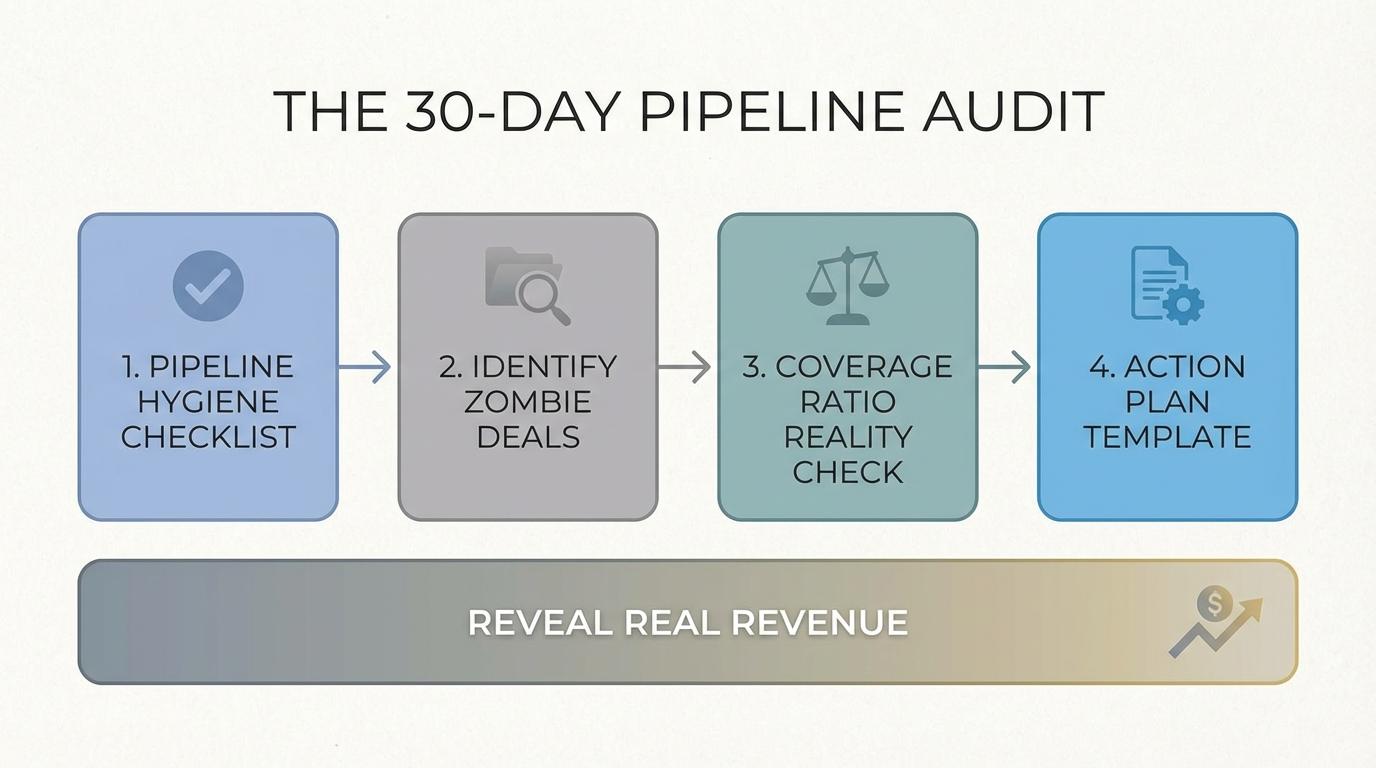
A 30-day pipeline audit cuts through the noise. It forces you to confront reality, identify the dead weight, and rebuild your forecast on deals that will actually close. Here’s exactly how to do it.
Week One: The Pipeline Hygiene Purge
Start with the uncomfortable work. Pull every open opportunity from your CRM and ask one question: When was the last meaningful activity on this deal?
According to Union Square Consulting, the biggest indicator of a zombie deal is how long it has been stuck in a stage. Find opportunities sitting in the same stage for 2x your normal sales cycle length. Those are your zombies.
Here’s your hygiene checklist for each deal:
- Has the prospect responded to outreach in the last 14 days?
- Is there a confirmed next step with a specific date?
- Has the deal moved stages in the last 30 days?
- Can you name the economic buyer and their timeline?
- Is there documented budget authority?
If a deal fails three or more of these criteria, it needs to be closed out or moved to a nurture track. Yes, this will hurt your pipeline number. But one real-world case study found that $9 million out of an $18 million pipeline, a full 50%, consisted of zombie deals. Better to know now than miss your number later.
Week Two: Identifying Your True Zombie Population
Now dig deeper into the deals that passed initial screening. Zombies are sneaky. They often look alive because a rep keeps “following up” without any real engagement happening.
The average SaaS company with a 3-6 month sales cycle has 4-10% of their pipeline as zombies at any given time, according to Inflexion Point. But that percentage climbs dramatically when sales teams are measured on pipeline size rather than pipeline quality.
Here’s what creates zombies:
- Reps keeping deals open to meet 3x or 5x pipeline requirements
- No strong business case documented for the prospect
- Champion left the company but deal stayed open
- Budget got reallocated but no one updated the CRM
- Prospect is “interested” but has no compelling event driving a decision
Run this analysis: What percentage of your pipeline has been stuck for longer than your average sales cycle? According to Mural, if 25% of your pipeline hasn’t moved stages in a month, your true coverage is probably much lower than you think.
Lost opportunities take 10x longer to close than wins. That’s not a typo. If your average deal closes in 60 days, those stalled opportunities have been sitting there for 600 days on average. Time to let them go.
Week Three: The Coverage Ratio Reality Check
With your cleaned pipeline, recalculate your coverage ratio. Most B2B teams target 3-4x coverage. But that number assumes every dollar in your pipeline has equal probability of closing. It doesn’t.
According to Mosaic, you need to match your coverage ratio to your historical win rate. If you close 25% of deals, you need 4x coverage minimum. If you close 33%, you can work with 3x. Simple math, often ignored.
Here’s the reality check framework:
Calculate your real coverage:
- Take your cleaned pipeline total
- Weight each deal by stage probability (early stage at 10%, late stage at 70%)
- Sum weighted values
- Divide by quota
That weighted number is your true coverage. If it dropped from 4x to 1.5x after cleaning, you have a pipeline generation problem masquerading as a healthy forecast.
Forecastio reports that inaccurate or outdated pipeline data contributes to up to 27% in lost forecasted revenue across B2B sales teams. Your cleaned, weighted pipeline won’t guarantee you hit your number. But it will tell you the truth about where you stand.
Week Four: Building Your Action Plan
You now know your real pipeline health. Time to fix the gaps.
If coverage is below 2x: This is a red flag. You need immediate pipeline generation activities. Double down on outbound, accelerate marketing campaigns, and consider whether quota is realistic for this period.
If coverage is 2-3x: You’re in the danger zone. Focus on accelerating deals in late stages while simultaneously generating new opportunities. Review each mid-stage deal for next steps that can be pulled forward.
If coverage is 3-4x: Healthy territory. Maintain your generation activities and focus on conversion optimization. Ask: what’s preventing late-stage deals from closing faster?
Your 30-day action template should include:
- Daily: Update CRM with last activity date on every deal you touch
- Weekly: Review pipeline coverage and identify at-risk deals
- Bi-weekly: Conduct pipeline review with manager focused on deal quality, not just quantity
- Monthly: Purge zombies and recalculate weighted coverage
According to Xactly, companies with strong pipeline management grow revenue 28% faster. The discipline of regular audits isn’t just about forecasting accuracy. It’s about building a revenue engine that actually works.
Key Takeaways
Your pipeline is probably lying to you. Between zombie deals, stalled opportunities, and optimistic close dates, the gap between what your CRM shows and what will actually close can be massive.
The 30-day audit forces confrontation with reality. Week one cleans out obvious dead deals. Week two identifies hidden zombies. Week three recalculates your true coverage. Week four builds the discipline to maintain pipeline hygiene going forward.
Will it hurt? Yes. You might discover your 4x coverage is actually 1.5x. But that pain now prevents the much worse pain of missing your number because you were managing a fantasy instead of a forecast.
Start your audit today. Your future self, and your commission check, will thank you.