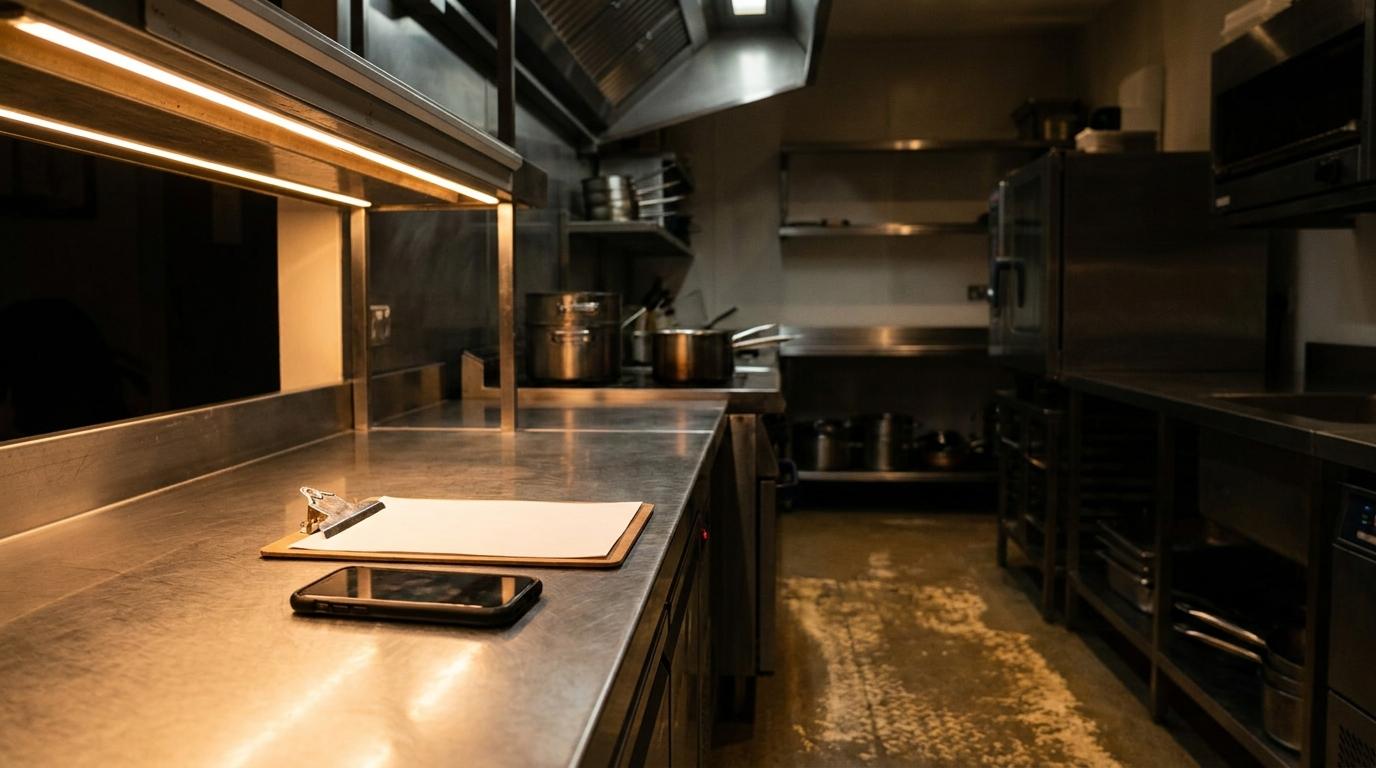
When the last pan goes into the pot wash and the extraction fans finally cut out, the kitchen gets so quiet you can hear the walk-in ticking over, and that’s when the ordering happens. It’s usually somewhere past 11 p.m. The floor is still wet and smells of degreaser, the pass is wiped down, and the only light left on is the lamp under the hood, throwing a warm yellow strip across the steel. You count what’s left in the walk-in, write it on the stock sheet on the clipboard, and lean on the counter with your phone. Then you send the order. Not through the portal your supplier set up for you, but as a text or a thumb-typed email to a person you know will read it in the morning.
I did that for years on the line, and I still do a version of it now that I buy for a small group of cafes. My supplier’s portal login lives in my password manager, untouched since spring.
Distributors put real money and thought into an online ordering portal, and I understand why. On paper it sorts out everything at once: buyers pick from your actual catalogue, codes and pack sizes come through right, and nobody on your side retypes a thing. Then the orders keep arriving by text and email anyway, and somebody in your office starts to wonder what’s wrong with your customers.
Nothing is wrong with them. They’re tired, and the portal was built for someone sitting at a desk.
Nobody calls it by its product code
For months I had a login for that supplier’s portal. I tried it a few times when they set it up, honestly tried, and then quietly went back to texting the rep. The reason was cream.
Every week we need double cream, and in my head and on our shelf it’s simply “the double cream”, the tall carton with the green cap that lives by the door of the walk-in. The portal wanted a product code, or failing that, a name that read like it had been written for a warehouse system, with the fat content, the pack size and a brand abbreviation crammed together in capitals. Searching for double cream at that hour gave me a column of near-identical lines and a spinning wheel. So I closed it and texted the rep, the way I always had: double cream, usual amount, small lemons not the big ones. I knew exactly what that did to his morning. He’d have to read my message, work out which cream I meant, and key it all into their system himself, which was the very job the portal had been built to take off him. I did it anyway, week after week.
Close-down has its own soundtrack, and mine was usually Table Manners, Jessie Ware and her mum chatting to a guest about food, playing from a little speaker above the pot wash. There’s something faintly ridiculous about hearing people reminisce about what they ate growing up while you count tubs of mascarpone in a fridge cold enough to numb your fingertips. By the end of an episode the order was usually sent, by text, without a moment’s thought.
A text asks almost nothing of you. It goes to a person who knows your kitchen, who’ll ring if something looks off, and who remembers that you always mean the small lemons. A portal asks you to remember a password, find each product, pick a pack size, check the delivery day and press confirm, all with damp fingers on a phone that’s nearly out of battery. None of those steps is hard, but stacked together at the end of a long shift they’re enough to send you straight back to your messages.
Not every buyer is me, though, and portals deserve a fair hearing. The person at a restaurant group’s head office, ordering for several sites from a desk with a proper screen and a coffee going cold beside the keyboard, often likes them a lot. Central purchasing teams want a record of every order, approvals, the same codes every week, and a B2B ordering portal hands them exactly that. Plenty of independents take to them as well, usually the ones where the owner does the ordering from the office in the afternoon. In my experience the split has less to do with size or age than with where the person is standing when they order: at a desk, or at the counter.
The counter people, in my experience, mostly won’t switch, however good the training session is. You can walk a sous chef through the portal on a quiet afternoon and watch them nod along, then get their order by text that same night. Their order gets written where the stock is, and the stock is nowhere near a desk.
What running both really costs
From my side of the counter, the portal looked like the supplier’s problem solved. It took a few chats with that very patient rep to see what it looked like from his side.
A portal keeps costing after it’s built. Somebody has to keep the catalogue in it right: prices, pack sizes, what’s out of stock this week, the new cheese that came in on Tuesday. Then there are the calls from buyers who’ve forgotten their password, and the friendly emails asking customers to give it a go, followed by the slightly less friendly reminders. Meanwhile the inbox hasn’t gone anywhere. Texts are still landing on the rep’s phone at night, and the order desk is still typing in orders like mine every morning. You haven’t replaced the old way of ordering. You’ve added a new one beside it.
So now there are two order channels, and the same handful of people minding both.
The overlap is where it gets fiddly. A buyer puts most of an order through the portal, then remembers the lemons and texts them to the rep. Another orders on the portal and emails to check it arrived, and on a rushed morning that email gets read as a fresh order. Most days somebody catches it. Some days the kitchen gets two lots of cream and an apologetic phone call.
None of this makes the portal a mistake. For the head-office buyers it probably earns its keep. It just doesn’t make the inbox go away, and planning as if it will is how a distributor ends up short-handed on the channel its kitchens actually use.
Take the order however it turns up
The suppliers I like ordering from most have stopped fighting about this. They keep the portal for the buyers who want it, and they treat the email, the PDF out of a chain’s purchasing system and the photo of a scribbled stock sheet as every bit as real. Some of them now use software that reads orders however they arrive, by email, PDF or photo, and matches each line to the distributor’s own product list, with a person stepping in only when a match isn’t clear. So if I email “the double cream, usual amount”, it can turn into the right product code without me learning anyone’s catalogue, and without the rep keying in my shorthand by hand.
Somewhere tonight it’s past 11 p.m., the fans are off, and a phone is lying face down on a steel counter next to a clipboard, under the warm strip of light from a hood lamp. The order has already gone, in somebody’s own words: the double cream, the usual amount, small lemons not the big ones. Somewhere in a password manager, the portal login sits untouched. Whoever reads that order in the morning can sigh at it or simply take it, and the kitchen will remember which one you did.