Peeling a strip of masking tape off the roll with my teeth, because the scissors had wandered off again, was how every Sunday night ended at the first café I bought for. Behind me the walk-in hummed its low compressor drone, the one you stop hearing after your first week, and the steel door was cold enough that the tape curled at the corners before I could press it flat. On it, in fat black marker, went the week’s changes: less oat milk, extra eggs for a Thursday catering job, no more blood oranges because the season had turned and the last box tasted like a sigh. It was never neat. By Wednesday the strip would have a coffee ring on it and a floury thumbprint where somebody had leaned in to read it, but it was the only place in the building where this week was written down as this week.
I still do it at home, on the fridge. My flatmate calls it a personality trait, and she is not wrong.
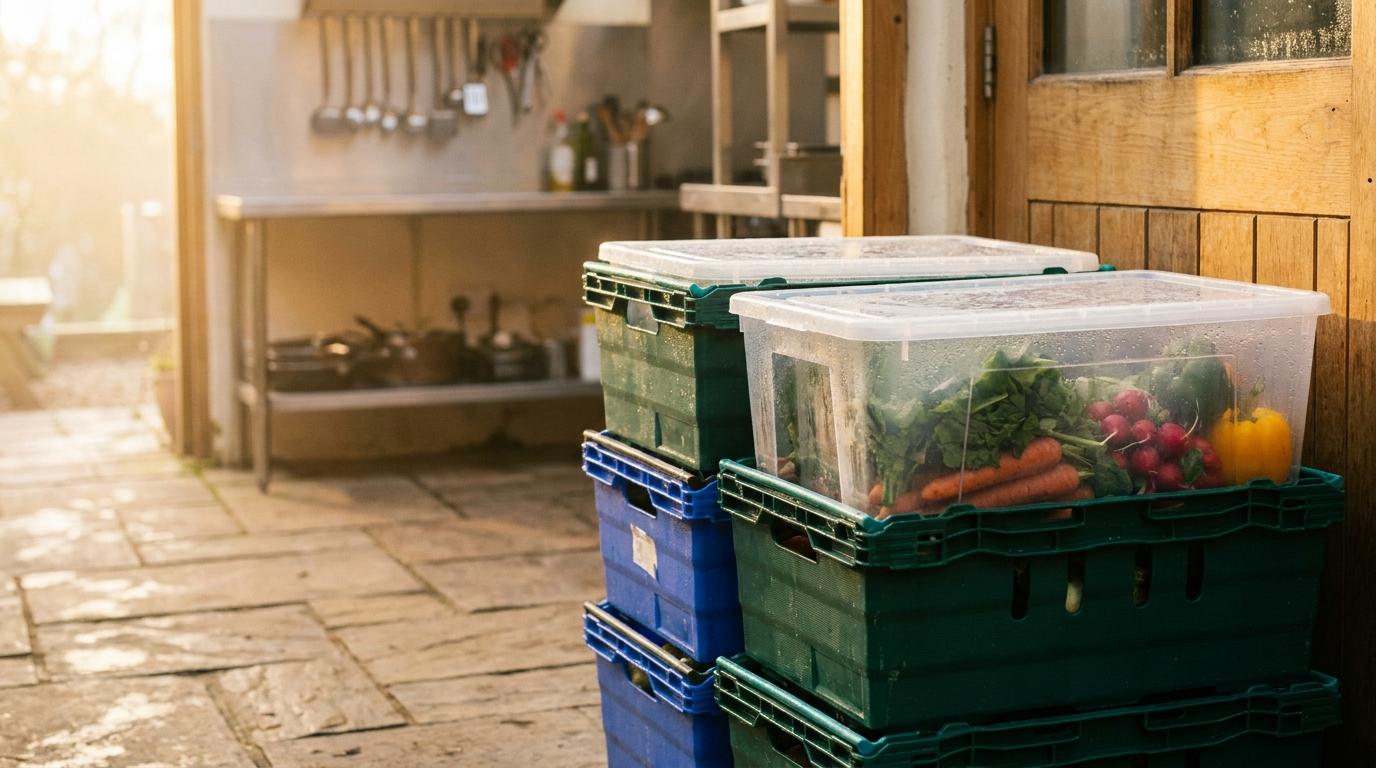
What that tape was really for, though I didn’t have the words for it back then, was the standing orders. Every kitchen I’ve worked in ran on them: the same milk, bread, eggs and salad leaves turning up on the same mornings without anybody picking up a phone, crates stacked by the back door before the first person arrives, early light catching the beads of condensation on the plastic lids. You set them up once with your food distributor, usually in a long, friendly conversation during the first week of an account, and after that they simply happen, the way the bins get emptied and the hood filters get swapped. Nobody thinks about them, which is exactly what everyone wants from them.
That last part is what I want to talk to distributors about, from the kitchen side of the back door. Orders that arrive as wonky photos and half-legible PDFs get read properly, because they have to be read to exist at all. A standing order doesn’t arrive. It sits in your system as a set of lines someone typed months ago, and every week that goes by it gets a little more likely to be describing a kitchen that isn’t there anymore. Nobody on your side did anything wrong to make that happen, and honestly nobody on mine did either, at least not on purpose.
Nobody sends it, so nobody reads it
Picture how every other order reaches you. A chef emails before service with her hands still damp from the sink, a group buyer sends a tidy PDF from an office upstairs, a kitchen porter photographs the clipboard on the prep table and texts it over with a thumb in the corner of the frame. Each of those lands in front of somebody on your order desk who reads it, works out what was meant, matches it to what you actually sell, and notices when something looks off, like enough butter to grease a ship arriving for a café with a handful of tables. That reading is the moment mistakes get caught, and it happens dozens of times a morning without anyone calling it a safety check. Your standing orders skip it entirely. They roll forward on their own, week after week, and the only time anyone looks at them closely is when a kitchen rings up irritated about something that turned up on the truck.
That’s why the weekly order nobody sends is the riskiest order you handle, and it isn’t because it’s complicated. It’s because nothing about it ever asks to be checked.
“The order’s not wrong, it’s just from last month”
Changes do come, of course. They just come at the worst possible hour and through the worst possible door. After service, when the kitchen has finally gone quiet apart from the dishwasher thumping through its last cycle and the slap of a squeegee pushing water toward the floor drain, the head chef leans against the cold steel of the pass and texts your rep: drop the cream this week, double the butter, we’ve got a wedding on Saturday. No capital letters, a typo in “butter,” and a thumbs-up emoji that could mean anything at all. To the chef, that message is the order now, settled and filed somewhere in the back of a very tired head.
From where I stood, that felt like ordering. The message was sent, the rep had seen it, job done, go home and sleep. What I didn’t picture, until I started buying for the cafés and talking to reps most days, was where that text went next: into somebody’s personal phone, late at night, to be remembered in the morning and keyed into a standing order that might already be printed on a pick sheet. If you’ve ever watched the 7 a.m. order rush at a food distributor, you know the morning doesn’t have a slot labelled “things a chef said last night.” Plenty of those texts get through perfectly. Some land on the wrong week. A few stay on the phone forever, and nobody notices until a crate turns up that nobody wanted.
The loud changes, though, were never the ones that caught me out.
Every year, as soon as the weather turned warm, we put a summer salad on the board at the cafés, watercress and peach with a crumble of salty white cheese and far too much black pepper, and it stayed until the peaches went mealy and the mornings started smelling of wet leaves. One autumn I changed the menu, had the new boards chalked, briefed the floor staff, and felt extremely organised about the whole thing. What I forgot was that the standing order still brought two cases of watercress every Tuesday. For a month they kept coming, cold and squeaky in their dripping boxes, and for a month our prep cook found new and increasingly desperate ways to put watercress on things. Watercress soup, I can tell you, is a hard sell in a café that mostly does toasties.
My first instinct was to blame the supplier. Sitting on an upturned milk crate in the dry store with my laptop balanced on a sack of flour, I drafted a slightly sharp email about sending things we hadn’t asked for, the kind with “as discussed” in it twice, and I was a click away from sending it when it occurred to me to check what we had actually asked for, which was, of course, exactly this. Nobody at the distributor had done anything wrong. I had simply never told a soul the salad was gone.
It was our sous chef who put it best, standing in the walk-in with a box of watercress on her hip and the evaporator fan blowing her fringe sideways. “The order’s not wrong,” she said, shrugging at the box. “It’s just from last month.” I have thought about that line more than almost anything else anyone has said to me in a kitchen. A standing order is a perfectly accurate record of what a kitchen wanted at some point in the past. Kitchens move, though. Menus turn over with the seasons, a dish gets cut because it’s slow on the pass or nobody orders it, a new chef arrives with strong opinions about bread, and the order carries on describing the old kitchen with total, cheerful confidence.
That’s what makes seasonal changes so slippery. Nobody decides to keep ordering watercress; it just keeps turning up, because stopping it needs someone to remember, and the person who changed the menu is busy thinking about the new menu, the new prep list and the new allergen notes on the new boards. It’s the same reason a gym membership tends to outlive the gym habit by a good while, quietly renewing itself long after anyone has stopped going.
On your side of the truck, those cases look like a steady customer. In the kitchen they look like waste, and after enough Tuesdays they start to look like a reason to try somebody else.
A strip of tape, or something like it
The reps I trusted most when I was buying all had some version of my masking tape. Not literally, though one of them did carry a battered notebook held shut with a rubber band, but a single written place where each kitchen’s standing order lived as it is this week rather than as it was the day the account opened. It wasn’t the rep’s phone, or a sticky note curling off the edge of someone’s monitor, or the memory of whoever happened to take the call. Every change, whether it arrived as a text at midnight or a careful email with a proper subject line, ended up written there along with the week it started and, ideally, the week it stopped. None of it needs to be clever, either: a spreadsheet tab per kitchen does the job, as long as everybody knows it’s the one that counts. When an order quietly drifted away from what the kitchen needed, there was at least somewhere a person could notice.
Most of that comes down to where changes land in the first place. If a chef’s late-night text, a buyer’s PDF and a photo of a scribbled list all end up in one shared inbox for every customer order instead of scattered across personal phones, somebody can actually see them over the first coffee of the morning. Ask your reps to forward anything that touches a standing order, even a text that just says “no cream,” and suddenly it stops depending on anybody’s memory. Write the change against that kitchen’s standing order with the date it starts, and if the chef said “just this week,” write down when it goes back, because a chef who says “just this week” will not be texting you to cancel the cancellation.
The best thing a rep ever did for me was reply to a midnight text the next morning with one plain line of order confirmation: cream off from Tuesday, back on when you say. I knew it had landed, and I knew someone was holding the other end of it.
Reading all of it is still work, and on a busy morning the work is where things slip. A lot of wholesale food ordering still runs on texts, photos and PDFs that nobody designed to be read by someone in a hurry. This is one place where software really has got better, and you can now process orders faster without retyping a PDF or squinting at a photo of a handwritten list. No tool will remember the summer salad is gone, and I wouldn’t want you to think it would. What it can do is make sure the orders kitchens do send get read properly and quickly, which leaves your people more time for the orders nobody sends.
Then, every so often, ask the kitchen. Not “is everything okay?”, which gets you a distracted “yeah, all good” from a chef staring at a full ticket rail, but “is this still what you want on Tuesdays?”
I still write my tape on Sunday nights, even though nobody reads it now except me and a fridge full of leftovers and a jar of chutney I keep meaning to finish. It’s less about the list than about the minute of standing there, marker in hand, asking whether last week is still true. Kitchens will always change faster than they tell you, and some of them, like me and my watercress, won’t notice they haven’t told you at all. So when you look at the standing orders going out on your trucks next week, how many of them are still describing a kitchen that’s actually there?